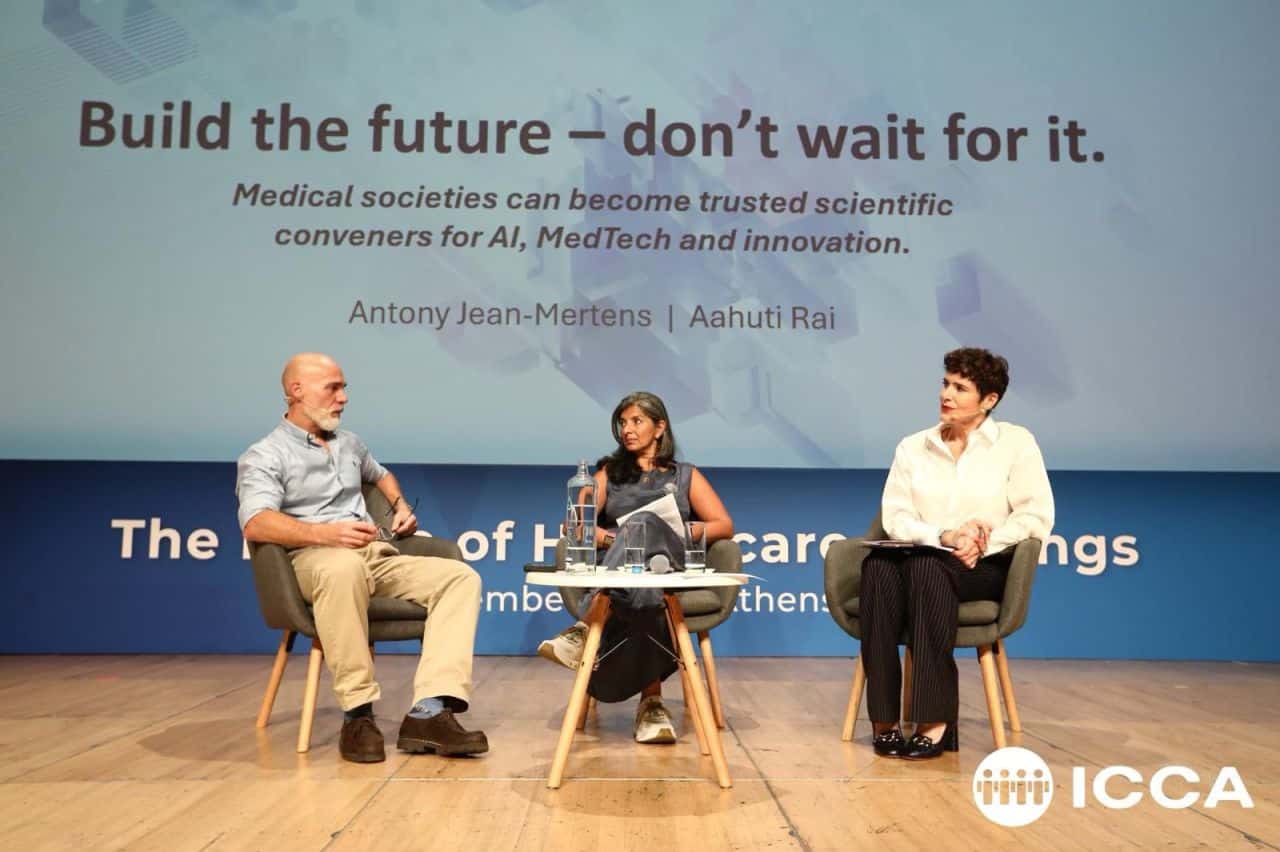
A conversation with Aahuti Rai and Antony Jean-Mertens
Artificial intelligence (AI) and medical technology (MedTech) are raising new questions for medical and scientific associations. How can they help members assess emerging applications, connect innovators with clinical expertise and encourage responsible innovation while protecting their scientific credibility?
The ICCA Future of Healthcare Meetings (Athens, 20–22 September 2026) explored how medical meetings are evolving. Following their joint presentation there, we spoke with Antony Jean-Mertens, Executive Manager of ECTRIMS (European Committee for Treatment and Research in Multiple Sclerosis) and Head of Association Management at Congrex Switzerland, and Aahuti Rai, Founder and innovation adviser at Four Points Consulting.
Antony shares how ECTRIMS is developing its approach to AI and innovative technologies, from establishing an innovation task force to exploring new educational tools and congress formats. Alongside this practical perspective, Aahuti explains the strategic questions and governance foundations that can help associations guide their decisions. Together, they explore how medical associations can connect emerging technologies with clinical expertise and build collaborations that support their scientific mission.
Disclosure: Aahuti Rai, through Four Points Consulting, has advised ECTRIMS on its innovation strategy.
Connecting technology with clinical expertise
Congrex: Antony, you attended HLTH Europe in Amsterdam two years ago, Europe’s largest annual healthcare innovation conference. What were your key takeaways?
Antony: I was particularly impressed by the diversity of people attending. Alongside pharmaceutical companies, there were health ministries, non-profit organisations, technology companies, start-ups, hospitals and regional development organisations. I knew these different parts of healthcare existed, but I had never seen them all brought together under one roof.
Some innovators told me that, although the event was interesting, they were not connecting with the clinicians who might use their technologies. One founder working on an eye-related technology had never heard of EURETINA (European Society of Retina Specialists) when I suggested it as a relevant professional community. That conversation stayed with me. Some companies were very focused on developing their products but had limited connections with specialist medical societies. I saw an opportunity for associations to help bridge that gap.
Congrex: Aahuti, what role can associations play in connecting these communities and stakeholders?
Aahuti: I see the association’s role as a convenor with scientific purpose. The opportunity is to bring people together around an important healthcare problem, not simply to bring more technology companies into the congress.
Look beyond the annual meeting to education, fellowships, research support, guidelines and professional networks. That matters because a useful connection made at a congress needs somewhere to go afterwards. I would start with a small number of priorities identified by the scientific community. Then bring together the people needed to address them: clinicians, researchers, patients, developers, hospitals, universities and, where relevant, investors or public institutions.
Defining the role and building the foundations
Congrex: Antony, how did ECTRIMS turn this opportunity into a strategy?
Antony: In our discussions with Aahuti, an important starting point was to clarify the association’s role. We needed to speak with scientific leadership about how ECTRIMS should position itself in relation to AI and innovative technologies more broadly. We did not want to claim that we had all the expertise to judge every emerging technology. Instead, we reached out to our community to identify people who could help us assess opportunities and develop a roadmap. We established an innovation task force, TechTRIMS, and brought in expertise from a group working on AI and innovative technologies in MS. The aim is to build the scientific capacity to guide this work, with the Secretariat supporting coordination and scientific leadership making the decisions.
Congrex: Aahuti, what should medical associations clarify about their role and mission before deciding how to engage with AI?
Aahuti: I would start by being clear about the role the association is taking and how each activity relates to its core mission. Associations have built credibility over many years. The question is how AI can support that mission, strengthen their work or help their communities. Using AI internally, educating members about it, hosting a technology discussion and recommending a clinical solution are very different activities. They should not carry the same approval process or imply the same level of assurance. That distinction needs to be clear before an association decides what it will offer or support.
Congrex: Aahuti, what governance foundations would you recommend?
Aahuti: I would put a clear mandate and accountability in place before developing an association product or entering a technology partnership. Otherwise, commercial activity can move faster than the association’s ability to evaluate what it is supporting. I would recommend a small, multidisciplinary group with a defined remit and a clear reporting line to leadership. It should bring together scientific and clinical expertise, digital and data expertise, education and operational delivery, with access to legal and regulatory advice. Patient perspectives should be included where the work could affect care or patient-facing information. I would begin with a limited number of well-defined activities, learn from them and strengthen the framework as experience develops.
RELATED CONTENT: Association Innovation: A Practical Guide to Driving Growth in 2026
Putting the strategy into practice
Congrex: Antony, in which areas is ECTRIMS exploring the use of AI?
Antony: We want our approach to extend beyond talking about emerging technologies at the congress. We are looking at how they could support education, clinical knowledge and the way we work. AI is one priority of the congress content, with a focus on its practical clinical use: what good practice looks like, what the limitations are and what professionals need to understand before using these tools. We introduced dedicated congress tracks at MSToronto and will continue developing them in Vienna in 2027
We are also embedding AI into our new certification platform. The platform uses members’ professional profiles and learning histories to recommend educational modules relevant to their certification pathway. Another area is clinical guidelines development, where the committee is actively exploring how AI can accelerate guideline production to save time and resources.
Congrex: Aahuti, where is AI already creating tangible value in healthcare and scientific communities?
Aahuti: The clearest value is often in a specific task: reducing the time required to do something, helping professionals work through complex information or supporting a more consistent process. Radiotherapy planning is a useful example. AI can help outline structures on scans, reducing some preparatory work, while a trained healthcare professional reviews and, where necessary, edits the output. It supports expertise rather than replacing it. That gives us a sensible test of value: does it save time without compromising quality or safety?
For associations, I would look carefully at education and access to knowledge. Congress content, educational resources, research networks and professional communities are substantial assets. AI could help connect that knowledge in ways that support new scientific enquiry. For example, an association could explore using AI to identify emerging patterns or unanswered questions across published research and congress abstracts, then bring researchers together to develop and test new hypotheses. Any AI-generated insight would need to be traceable to the evidence and treated as a starting point for research, rather than a scientific conclusion.
AI should address real needs, but we should also ask what it makes possible that we would not previously have considered. The balance is to stay grounded in practical value without limiting ourselves to improving existing processes.
RELATED CONTENT: Innovative Strategies for Continuing Medical Education Events
Designing congress formats with scientific credibility
Congrex: Antony, what congress formats are you developing for Vienna in 2027?
Antony: We are planning an innovation session where selected start-ups and other innovators can present technologies relevant to MS. Short presentations will be followed by questions and discussion, with a panel bringing together scientific expertise, patient perspectives and knowledge of AI and other innovative technologies.
We are also developing the concept of a TechTRIMS Village to connect the host city’s health and technology communities with congress participants. By inviting past and future host cities to remain involved, we aim to build relationships that continue across successive congresses.
Alongside these opportunities for exchange, the scientific programme will explore AI and other innovative technologies in research and patient care, helping participants understand their potential applications, the evidence behind them and their limitations.
Congrex: Aahuti, how can associations protect their credibility when presenting emerging technologies?
Aahuti: The key is to distinguish exposure from endorsement. An association should be able to bring technologies into the conversation without implying that everything on its stage has been validated or is ready for clinical use.
I would make each solution’s status explicit. Is it an early research concept, a prototype, a product being evaluated or a solution with evidence in a defined setting? Then I would ask consistent questions about intended use, evidence quality, the populations studied, limitations and implementation requirements.
For an initiative such as the TechTRIMS Village, my recommendation would be to organise participation around relevant clinical or scientific challenges, rather than simply who can pay for space. Each demonstration should explain what the technology does, what has been demonstrated, what remains uncertain and what needs to happen next. Sponsorship should not buy scientific approval. Independent reviewers should control scientific selection, commercial relationships should be disclosed, and clinicians and researchers should have space to challenge claims.
Building lasting connections and measuring progress
Congrex: Antony, what is the overarching goal of this strategy?
Antony: We want to connect our clinical and research community with people working in digital health, including software developers, data scientists and health-technology founders who may not previously have known ECTRIMS.
There is also an opportunity for host destinations to introduce their universities, research centres and relevant companies to a specialist international community. If those relationships continue from one congress to the next, we can build a network that grows over time. Making this happen requires coordination, resources and time. We need to explain the concept, find relevant partners and make participation accessible. The ambition is to build lasting connections that support the association’s mission and create value beyond the event.
Congrex: Aahuti, how can associations tell whether their approach to AI and innovative technologies is benefiting members?
Aahuti: I would measure whether the association has become better at helping its community make informed decisions, not necessarily that it has more sessions on AI, exhibitors or partnerships. For me, success in three to five years would be a more capable professional community, a small number of credible collaborations and a repeatable way to assess new technologies. Choosing not to progress a weakly evidenced solution should also count as a good outcome. The ambition is not to be seen as the most enthusiastic association about AI; it is to be trusted to help the community distinguish what is useful, what needs further work and what should not yet be adopted.
Disclosure: Four Point Consulting has advised ECTRIMS on its innovation strategy.
FAQ
What role can medical associations play in healthcare innovation?
Medical associations can act as scientific convenors. They bring AI and MedTech innovators together with clinical experts around real clinical problems. Their independence and scientific credibility make them a trusted bridge between both communities.
How should a medical association start working with AI and new technologies?
Start by defining the association’s role and how each AI activity supports its mission. Then set a clear mandate, assign accountability and form a small multidisciplinary group. Beginning with a few limited, well-defined activities keeps the risk manageable.
How can congresses showcase new technologies without endorsing them?
Keep exposure and endorsement clearly separate. State how mature each solution is, and keep scientific selection independent of sponsorship. That way, participants can explore innovation while the association protects its credibility.
How can associations measure whether their innovation strategy works?
Success means members make better-informed decisions and the association builds credible, lasting collaborations. Declining solutions with weak evidence also counts as success.